Mechanisms of Stress sensing and Response in Life
Molecular Mechanisms of Cellular Responses to Oxidative Stress,
Hypoxia, and Low pH
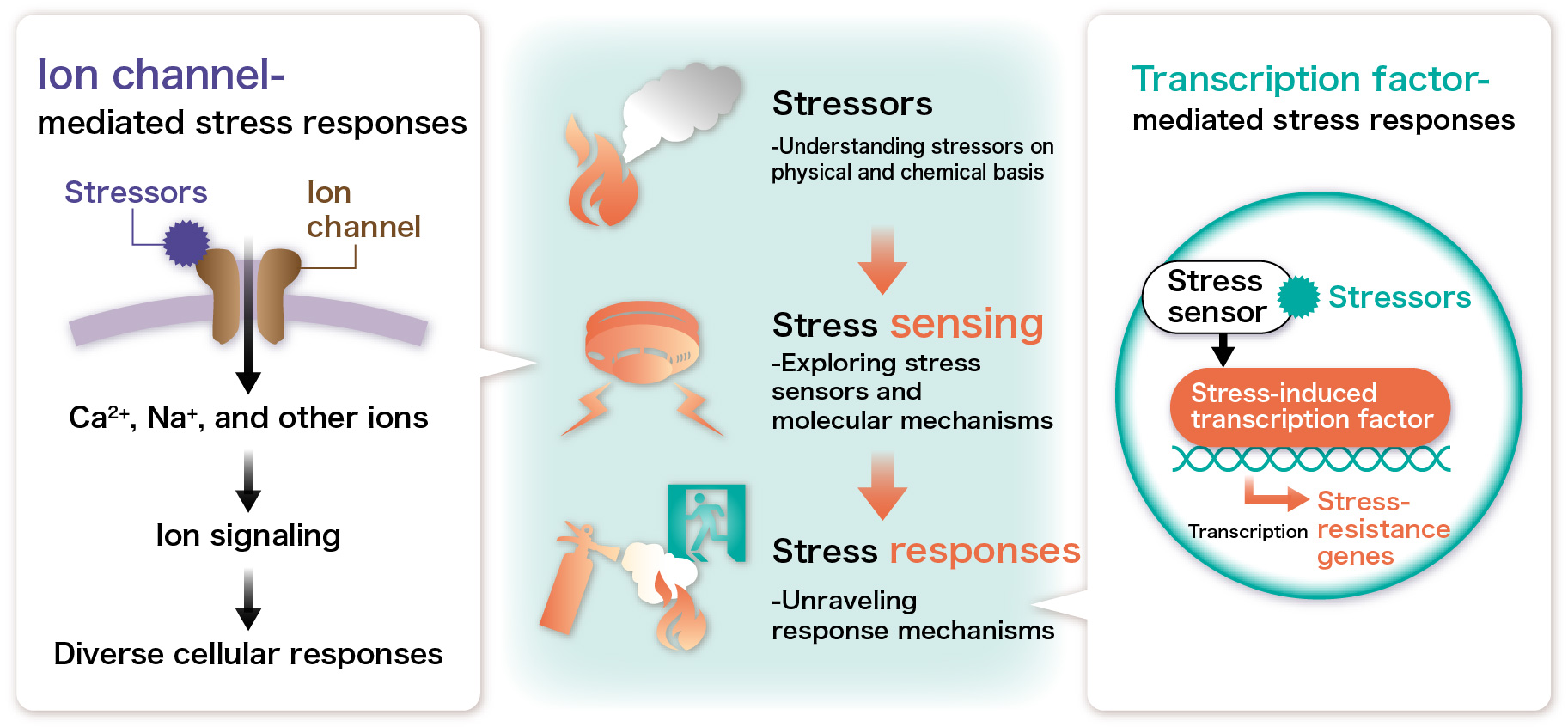
We were the first to demonstrate that a subset of the 28 TRP channels in mammals functions as intracellular sensors for reactive oxygen species (ROS) (ref.1-5). Among them, TRPA1 stands out as a “multimodal stress sensor,” capable of detecting not only oxidative stress but also hypoxic conditions (ref. 4). In this way, TRPA1 monitors two fundamental threats to life—oxidative stress and fluctuations in oxygen tension—and orchestrates physiological responses essential for survival.
These discoveries expanded the horizon of stress biology and marked the beginning of a new chapter in our research. We are now investigating stress-inducible transcription factors that orchestrate cellular adaptation to various forms of stress, opening yet another frontier. Our work is, in essence, a journey to uncover the sensors of life, and along this journey, discoveries surely await that may transform our very understanding of biological phenomena.
- Ref.1:Yoshida T et al, Nature Chem Biol 2006
- Ref.2:Yamamoto S et al, Nature Med 2008
- Ref.3:Takahashi N et al, Channels 2008
- Ref.4:Takahashi N et al, Nature Chem Biol 2011
- Ref.5:Takahashi N et al, Nature Commun 2014
Cancer Biology
Targeting Oxidative Stress Defense Mechanisms in Cancer:
Toward Innovative Metastasis Suppression
Cancer cells leave their original “niche” and continue to proliferate, exposing themselves to a variety of hostile conditions—metabolic disruptions, attacks from immune cells, and shortages of nutrients and oxygen. At the core of these challenges lies intense oxidative stress. To survive, cancer cells must acquire defense systems far more powerful than those of normal cells.
Our work has shown that TRPA1, a sensor for oxidative stress, provides one such protective mechanism (ref.1). We also revealed that cancer cells can die through a distinct oxidative stress-driven pathway known as ferroptosis, and that some cancers escape this fate through special adaptations (ref.2).
Building on this, we developed a unique ROS probe to map oxidative stress in tumors with single-cell precision. Using this approach, we demonstrated for the first time that immune cell-derived ROS creates local hotspots of oxidative stress where cancer cells begin to detach from the tumor mass through a process called “tumor budding” (ref.3). In other words, cancer cells not only “endure” oxidative stress but can also “evade” it—initiating the earliest steps of metastasis.
This discovery reframes metastasis not merely as the end stage of malignancy but as a survival strategy of cancer cells adapting to their environment. We are now working to block this “escape strategy,” aiming to develop long-sought approaches for suppressing metastasis.

- Ref.1:Takahashi N et al, Cancer Cell 2018
- Ref.2:Takahashi N et al, Molecular Cell 2020
- Ref.3:Ueda Y et al, Nature Cell Biol 2025
Mammalian Evolution
Unraveling the Mysteries of Red Blood Cell Enucleation and
the Emergence of Viviparity
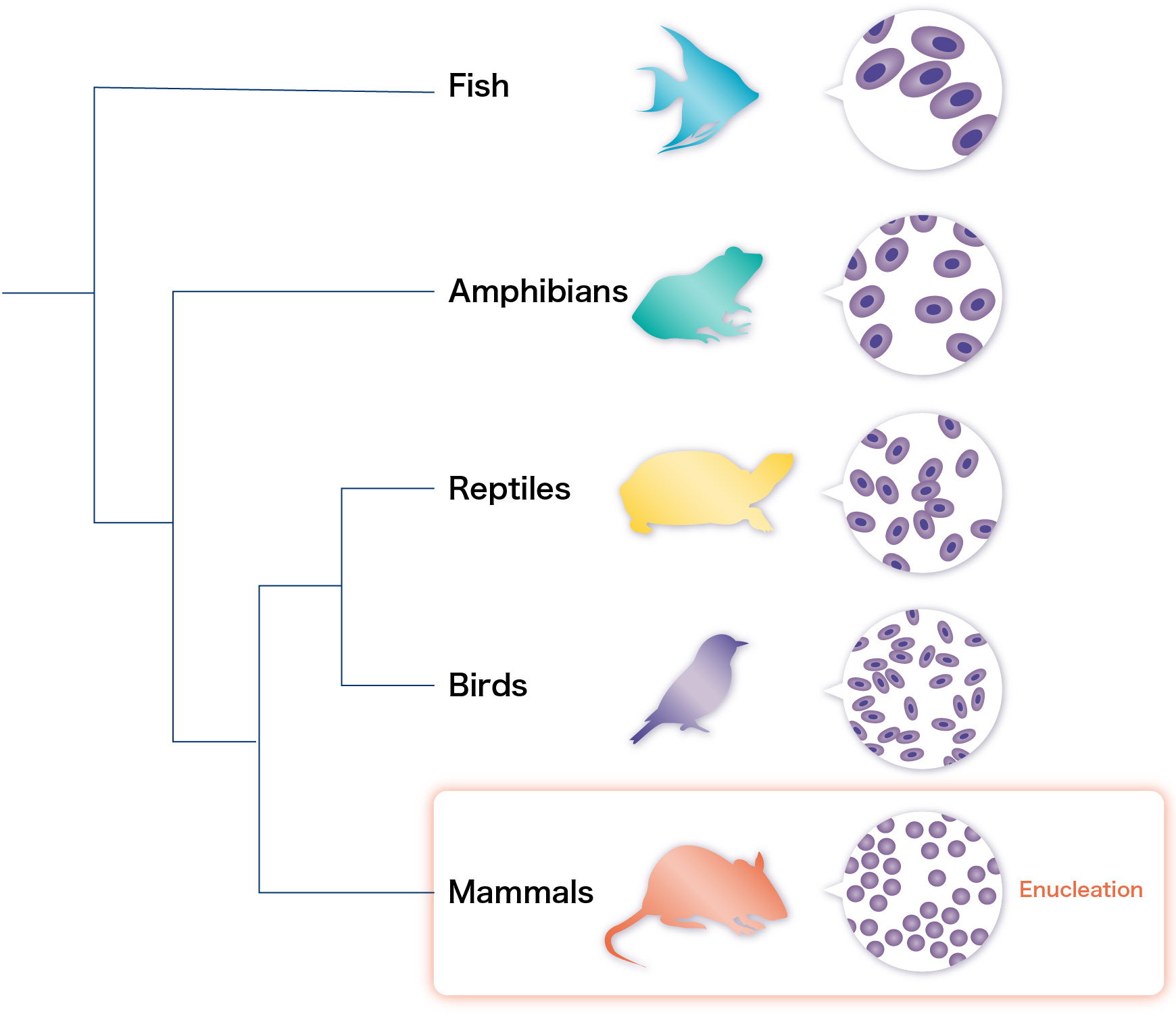
Mammalian red blood cells possess a remarkable property: during the final stage of differentiation, they expel their nuclei. This “enucleation” is unique to mammals, as birds and reptiles retain nuclei in their red blood cells. The evolutionary background and physiological significance of this phenomenon remain enduring mysteries in life science. We view enucleation as an adaptive strategy to stress that arose with mammalian evolution, and through comparative analyses across mammals, birds, and reptiles, we are probing the link between cellular architecture and stress responses. Here lie “answers to evolution” that have yet to find their place in textbooks.
We have also discovered that the emergence of viviparity in mammals required the acquisition of a novel oxygen-sensing mechanism. Viviparity confers clear advantages—it protects the fetus from external threats and enables direct nutritional supply—but it also imposes a heavy burden on the mother, increasing the risk of anemia and exposing the placenta and fetus to hypoxia. To overcome this vulnerability, mammals evolved a new oxygen sensor, which we identified for the first time. From the enucleation of red blood cells to the establishment of viviparity, seemingly disparate phenomena converge on a unifying principle of stress adaptation that links evolutionary innovation with the roots of human disease. Unraveling this dynamic interplay is at the heart of our research.
Chemical Evolution and Astrobiology
Probing the Origins of Life Through Chemical Evolution Research
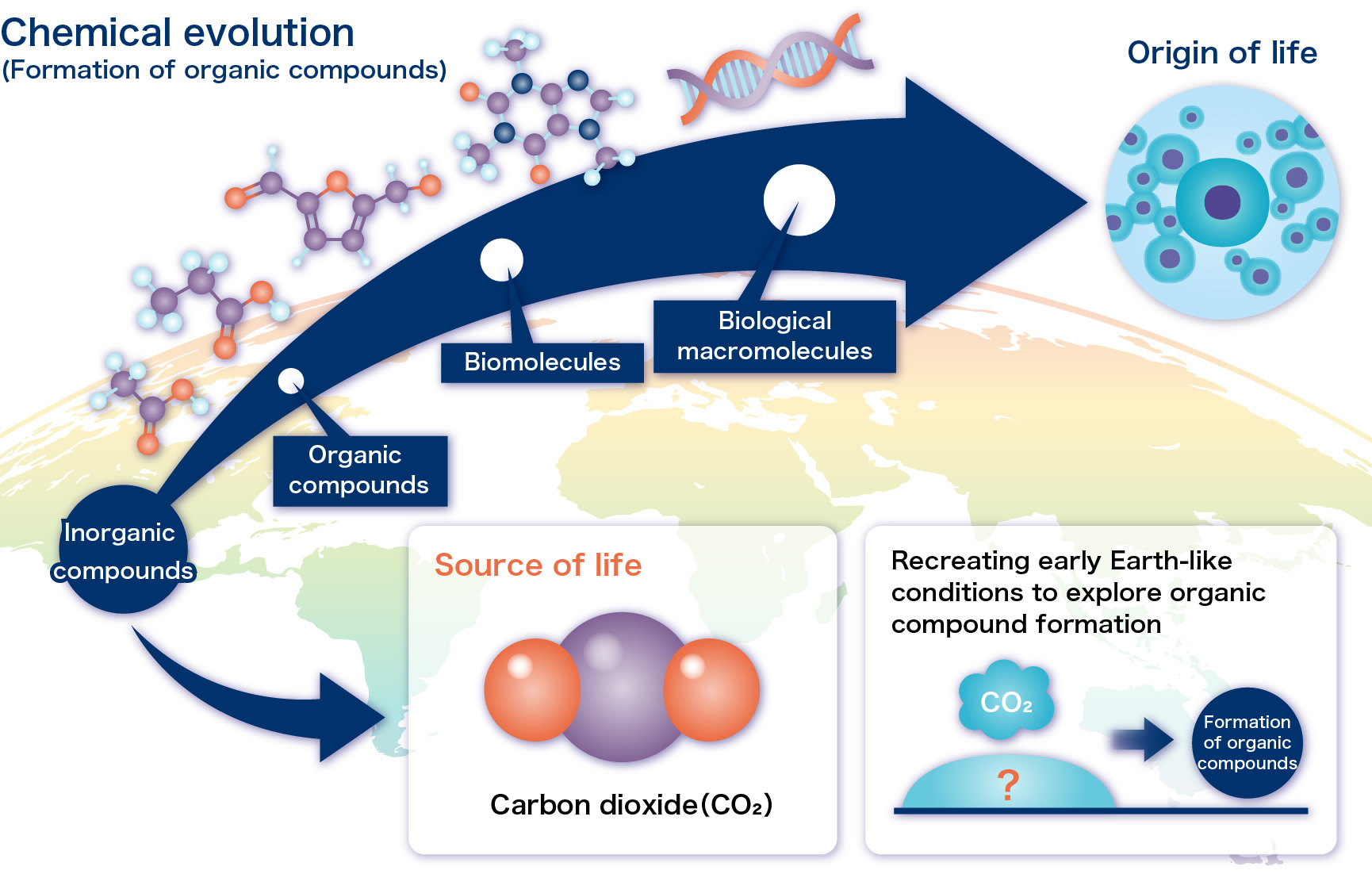
It is widely believed that the organic molecules forming the basis of life originated from carbon dioxide present on the early Earth. But how could such a simple molecule have been transformed into the building blocks of life? To tackle this fundamental question, we recreate early Earth-like conditions using meteorites and other materials, tracing the emergence of organic molecules under these environments. By dissecting the structural changes and reaction pathways of these molecules, we aim to uncover the chemical processes that could have paved the way for the origin of life.